How to build a fiberglass rocket, part 4: motor mount

With the airframe of the rocket nearly complete, I just needed to prep the area where fins will eventually go. The rocket is pre-slotted (i.e., it comes with slots already punched out to insert the edge of the fins), but the slots are all too narrow and needed to be sanded quite a bit to widen them.

In addition, I drilled 12 individual holes (one for each side of all 6 fins). Later in this assembly, I’m going to insert the fins into these slots, where their edges will be up against the motor mount tube inside this airframe. I’ll then inject epoxy with a syringe into each hole, and tilt the rocket back and forth to spread it around, ensuring that the fins are strongly secured in place both internally and externally. But I’m getting ahead of myself.

booster section of rocket airframe, with slots for fins
pre-slotted airframe

On to the motor mount tube!

This 75mm fiberglass tube has a slightly smaller diameter than the 4″ rocket airframe. (To be clear, I have no idea why the motor mount tubes are almost universally measured in metric units – 54mm, 75mm, and 98 mm being fairly common in high power rocketry – while the airframe itself is measured in inches. It’s a mystery for the ages.)

There are 4 beige colored fiberglass centering rings: the inner diameter of each ring fits snugly around the motor mount, and the outer diameter of each ring fits inside the larger airframe. The purpose of these rings, as the name implies, is to center the motor mount inside the airframe.

red motor mount with yellow kevlar recovery harness on workbench
motor mount with kevlar recovery harness

The primary goal here is to secure the yellow kevlar recovery harness to the motor mount. Later, I’ll attach a much longer kevlar cord to this one, and the other end of that cord will attach to one end of the e-bay (with a parachute attached as well).

This basically makes sure that the bottom part of the rocket, including the motor, stays linked to the e-bay in the middle of the rocket – and also makes sure that a parachute can deploy, when these parts separate after apogee. Since there’s nothing obvious to hook or attach this cord to on the motor mount, the solution is to simply epoxy it directly to the motor mount.

I measured the width of the cord (1 inch) and marked it on the top centering ring, and then sanded down a 1 inch width on both sides of the inner part of the ring, to allow just enough space for the cord to fit between the ring and the fiberglass tube. About 6 inches of cord are on each side of the tube.

motor mount with recovery harness tucked inside centering ring
before: tucked inside centering ring

After that, I created some very crude “dams” with masking tape since the epoxy is a bit runny before it cures. I put a generous amount of epoxy underneath the cord to bond it to the tube, and then even more on top of the cord, in order to totally encapsulate it.

Here you can see a “before” and “after” picture. I couldn’t quite get all the masking tape off afterwards because some was sealed and bonded (somehow I did not foresee this). But the cord is totally encapsulated. When the epoxy cures, it becomes incredibly hard and is similar to plastic.

recovery harness sealed in epoxy
after: sealed in epoxy

The recovery harness here is now thoroughly secured to the motor mount.

A few notes on epoxy, as this was my first time ever using it. It’s pretty straightforward, but there’s a slight learning curve. I used West System 105 resin and 205 hardener: these are two separate products that come in separate containers with pumps. You add them together (in a ratio of one pump each) into a mixing cup, and then mix them together (I used a popsicle stick) very thoroughly, for several minutes.

Once mixed, the epoxy begins to harden and cure much faster than I initially realized. It also gets very hot, from the chemical reaction – to the point where it’s literally giving off visible steam, and the heat from touching the outside of the plastic mixing cup will burn your fingers.

It’s also a bit runny when spreading, so it really helps to create a barrier or dam with masking tape to keep the epoxy where you want it, as it cures. The tape can easily be removed later.

I was previously used to working with wood glue for cardboard rocket sections and plywood fins, but fiberglass is a whole new experience. Wherever fiberglass pieces need to be permanently attached (e.g., the fins to the rocket body), this two-part epoxy is used, and it’s amazingly strong.

Next up: the nosecone.

How to build a fiberglass rocket, part 3: airframe prep

My first couple of posts related to the Darkstar Extreme were just recapping my progress in high power rocketry to date, and outlining everything that’s needed in order to build this particular rocket. But now I’m finally ready to begin assembly.

As mentioned previously, the “kit” basically includes all of the rocket airframe parts (shown below), along with some nylon recovery harnesses and miscellaneous hardware (steel screws, nuts, washers, forged eye bolts, and quick links). The first thing I did after unboxing everything was soak the fiberglass pieces in water for 24 hours, to remove any remaining mold release agent. In other words, as the proud parent of a new rocket, one of the first things you should do is to give it a proper bath.

fiberglass rocket airframe parts, soaking in water pre-assembly
exciting, fast-paced action!

After rinsing off and drying each piece, I moved everything out to the workshop. Time to begin construction of the workshop’s inaugural rocket.

Just to provide some overall structure for what I’m planning to do here: the idea is to assemble the fiberglass airframe, but in a way that allows it to separate at multiple key points in the future. In certain places I’ll use epoxy to permanently attach pieces together, but in several other locations I’ll need to measure and drill holes, and then insert small nylon screws (“shear pins”) which are strong enough to hold the pieces of the airframe together, but which also have the ability to shear in half when sufficient force is applied (e.g. a small controlled explosion), allowing the rocket to separate and a parachute to deploy.

fiberglass rocket airframe parts on workbench
marking the airframe for future drilling

To help visualize how all these pieces go together, the major components of this airframe (from top to bottom, when the rocket is standing vertically on the launch pad) are: the nosecone (grey, with aluminum tip) permanently epoxied to a 6″ coupler; a 24″ payload section; an 11″ coupler which serves as an electronics bay; and a 52″ booster section. There is also a 1.5″ band or ring that fits around the e-bay/ coupler, and six fins (three larger, three smaller). Inside the booster section is a motor mount with a smaller 75mm diameter and 4 centering rings.

fiberglass rocket airframe pieces on workbench, pre-assembly
labeled for your viewing pleasure

Here you can see a lot of measuring, marking, and drilling on the airframe. More specifically, there are 3 holes drilled in the nosecone/ coupler and the payload section, which can then be secured together (and later separated) with shear pins. Another 3 holes and shear pins connect the “bottom” of the e-bay/ coupler to the long booster section. And then three more holes – this time plugged with steel screws serving as rivets – connect the “top” of the e-bay/ coupler to the payload section. These steel rivets ensure the payload section does not separate from the e-bay during flight, but they allow diassembly on the ground by removing the rivets, if needed.

fiberglass rocket airframe parts, pre-assembly
crude but effective sanding technique

Finally, in the middle 1.5″ of the e-bay/ coupler, I marked the location of the band or ring that will be secured to the coupler with epoxy, shortly after this.

Aside from measuring, labeling, and drilling, I also needed to sand many parts of the fiberglass airframe. In general, it’s helpful to sand anywhere that epoxy will be used to ensure better bonding. This includes a few external areas (like the one pictured above), as well as the areas on the centering rings where they will touch the motor mount and the booster section; the edges of all six fins, along with the areas that the fins will touch on both the motor mount and booster section, and so on. Lots of sanding here with coarse (60 grit) sandpaper.

So begins the thrilling assembly of the Darkstar Extreme.

How to build a fiberglass rocket, part 2: specs

I provided a full list of materials that I’ll be using to build the Darkstar Extreme, but just to offer a little preview on what the completed rocket will look like, here are some of the specs. And the picture below is just an example of the finished version – to be clear, I don’t usually post pictures that aren’t my own, but my rocket will look similar to this once it’s done (just probably a different paint job).

completed darkstar rocket, painted red and black, on green grass
note: not my rocket
  • Length: 101 in. (about 8.5 ft)
  • Dry weight: 223 oz (about 14 lbs)
  • Airframe diameter: 4 in.
  • Motor mount diameter: 75mm
  • Altimeter/ flight computer: TeleMetrum
  • Backup altimeter: TBD
  • Main parachute: 8 ft diameter Rocketman parachute
  • Drogue parachute: 2 ft diameter Rocketman parachute
  • Motor: TBD

I’ve already started construction, so I’ll have a lot more updates coming soon.

How to build a fiberglass rocket: Darkstar Extreme

With the workshop newly completed, and a seemingly endless quarantine/ lockdown in effect, it’s time to turn my attention to building a new rocket.

fiberglass rocket parts spread across wooden workbench
ready to assemble

So far, I’ve built and flown a couple of low and mid power rockets, and I built one high power rocket – the HyperLOC 835, which is a 4″ diameter rocket made primarily from thick cardboard and plywood, with a 54mm motor mount. It can fly on an H, I, or J motor, and I plan to use it once launch events start up again for my L1 certification and probably for my L2 cert as well. It also gave me the opportunity to build my first electronics bay and learn more about flight computers and telemetry.

My next project is a bigger high power rocket: the Darkstar Extreme. This one also has a 4″ diameter but it’s made entirely from fiberglass (except for the aluminum-tipped nosecone and aluminum bulk plates). Fiberglass is significantly stronger than cardboard, wood, or other similar materials; it’s the strongest building material for rockets aside from aluminum.

The other chief advantage of this rocket is a larger 75mm motor mount. More powerful motors come in larger diameters, and this rocket can technically fly on a K, L, or even M motor. An M motor would require me to get my L3 certification, a daunting goal, though one that I plan to achieve in the not too distant future. But I could fly it on a K or L motor as soon as I get my L2 cert.

After unboxing this kit and soaking the airframe pieces in water for 24 hours, I’ve laid out the pieces on my workbench and am ready to start construction. The kit only comes with the major pieces: the fiberglass airframe and nosecone, a few aluminum bulkplates, some basic hardware (forged eye bolts, nuts, washers, and quick links), and nylon recovery harnesses.

The kit does not include the motor (of course), any parachutes, fire blankets, a motor retainer, or certain other necessary hardware (nylon screws/ shear pins, steel screws/ rivets, additional metal bulk plates, etc), so I bought those separately. I also splurged on some kevlar recovery harnesses rather than using the nylon ones that came with the kit because kevlar can withstand significantly higher temperatures and won’t burn easily.

I’ll post a more comprehensive bill of materials separately in case anyone is interested.

How to build a rocket workshop (part 10: the resurrection)

The much-anticipated finale to the workshop saga!

The last few posts covered the electrical work, from digging a trench to installing a sub-panel in the shed and running conduit out from the main panel in the house, and then the official inspection. I also briefly covered the similar process needed to run some ethernet cable out there.

With that work complete, it just left cleaning up and furnishing the inside to create a true workshop.

workshop interior view, with work benches and stool
welcome to the rocketry workshop!

Most of this work was mundane – sweeping up a cartoon-like cloud of dust around myself, using a shop vac to get up sawdust and debris, etc. I also set up a second workbench against the back wall, and a few houseplants just to lend some color to the shop. They get plenty of direct sunlight during the day through that window.

I installed a few shelves (see below) to hold bags and cases of tools and equipment, and got some circular holders to tidy up the multiple 100 ft extension cords. The fire extinguishers were already in the shed, but I decided to keep them around in case something catches on fire (extremely likely).

I also put up a second light fixture overhead (not pictured here), installed some additional pegboard for hanging tools, and a few other miscellaneous things.

workshop interior view, facing open door
shop vac helps tidy up

The primary reason I needed a workshop to begin with was just for more space – some workbench or table area to lay out parts, and measure, drill, cut, sand, glue, and generally build things. With that goal in mind, I can say: mission accomplished.

workshop interior view, with workbench and stoool
exit, stage right

Finally! Just a place to sit and assemble rockets. It’s only about 10×10 ft, but it’s a really practical space.

I may spruce up the inside or outside of this shop more over time, like adding some flooring, building a larger exterior deck/ porch, and so on. I have a few other ideas. But the core goal is complete, and I’ve already begun work on my next rocket, the Darkstar Extreme from Wildman Rocketry. Much more to come on that soon!

How to build a rocket workshop (part 9: tropical storm)

Since we had already done all the work involved in running copper wire and conduit outside to bring electricity to the shed, we figured we might as well run some cat 5 (ethernet) cable out there, too, for a wired ethernet connection. I mean, we’d already dug the trench – so why not? An excellent yet rhetorical question.

And as long as we’re running one cat 5 cable, might as well run two. Right?

white door on blue exterior wall, with grey pvc conduit above and to the right of the door
double the conduit

In view of the larger project of transforming the shed into a workshop, I have to concede that this step was really more along the lines of “what the hell” than anything else. I can’t say it was absolutely necessary. In fact, one might argue it was totally unnecessary. I can’t say that I have any immediate plans to use a wired internet connection out there. The wifi signal from the house certainly reaches the shed, if I needed it. I cannot imagine why I would need a wired connection.

And yet… we already dug the trench, which is the type of work that I’d never want to do again. It may be totally unforeseeable now, but in the unlikely event I suddenly need a wired internet connection in the workshop, it seems worthwhile to invest in just a small amount of extra time and effort now, instead of undertaking another huge (and avoidable) project later.

And to be honest, compared to running electricity out there, this was much easier.

open metal junction box with cat-5 cable and ethernet jacks
labeling the jacks for future reference

The PVC conduit (3/4″ this time, easily able to hold two ethernet cables) was laid in the trench about 8 inches above the other 1″ conduit with the electrical wires, still about 10 inches below ground level. Next to the house, the conduit runs up vertically along the wall and then over a door and off to the side, right next to the 1″ conduit. I’ll paint them both blue to match the house, eventually, as well. At that end of the conduit, we ran the ethernet cable through the floor and wall of the house, and installed a 4-jack outlet inside, next to the modem/router.

On the other end of the trench, the conduit came up inside the shed to a single junction box, pictured here. It was basically the same process as the electrical wiring, just much simpler inside the shed with a single piece of conduit and single box.

I labeled the jacks and ethernet cable on both ends for future reference and then slapped a metal box cover and 2-jack wall plate on top. Tested both jacks and they are perfectly functional. Success! I may not know why I did this, but I know that the objective was achieved.

two finished ethernet jacks with wall plate cover
ready to use

This means the wiring is complete and I’ve entered a new phase of this project: beautification. Basically, time to clean things up. Outside, there’s an enormous mountain of dirt and rocks that needs to go back into a deep trench and cover up the conduit. I also need to buy a few (hundred) bags of mulch to cover the bare soil, and make the building’s external appearance look at least marginally more presentable (not dissimilar to goals related to my own appearance).

Inside the shop, there’s some general cleanup to do and a few pieces to put back in place. I also need to spend a little time planning the design for the layout, and where tools and equipment should go. It may only be a small 10×10 ft space, but all the more reason that the layout matters: space is at a premium.

I’ll have a few more pictures and a final update once it’s complete. It’ll be ready for building rockets just in time for spring – a.k.a. rocket-building season.

How to build a rocket workshop (part 8: judgment day)

I alluded to the fact in the last two posts that there are some laws and regulations applicable to electrical work.

Among other things, your city or state will require you to obtain a permit (and pay a fee) before you can even begin the work. In Washington state, this is the Department of Labor & Industries. The work needs to be done in accordance with certain requirements, and then an inspection is required once it’s complete. At that point, you notify the Department and schedule a date, and an electrical inspector will come on site to review all of the work.

It’s not uncommon to fail an inspection and for remedial action to be required. An inspector can fail you no matter how small the violation, relative to the overall work done.

Judge not, lest ye be judged – amirite? Unfortunately, it’s literally the inspector’s job to judge – and he or she has significant power and discretion.

front of shed with door and new exterior light
purely cosmetic

What are the requirements governing electrical work? There are several, and they are no joke. I had to bring myself up to speed quickly.

First, there’s the National Electrical Code (“NEC”), which is published by the National Fire Protection Association (“NFPA”), in NFPA 70. Interestingly, this is the same NFPA that publishes the Code for High Power Rocketry (“HPR”), in NFPA 1127. But that’s a whole separate topic, worthy of its own blog post.

The NEC is “national” but is not technically a federal law. However, it has been adopted in all 50 states, which can also modify it as they see fit – so the rules can and do slightly vary from one region to another.

In Washington, there are state-specific statutes and regulations further modifying the standard NEC rules.

view of electrical panel in shed
where the magic happens

So what are these rules, exactly? There are far too many for a comprehensive list, but here are a few examples:

  • Conduit minimum depth underground. Copper wire must generally be enclosed inside conduit (metal/rigid or PVC) and, if horizontal and running across the ground, must be buried so the top of the conduit is at least 18″ underground.
  • Securing conduit. Conduit that is vertical and runs along walls (indoor or outdoor) must be secured with straps (plastic or metal) at no greater than 36″ intervals.
  • Conduit bends. You can physically bend conduit – with heat, if it’s PVC, for example – or you can attach 90 degree (or 45 degree) PVC “elbows” for turns. But the total turns cannot exceed 360 degrees. That means, for example, you could have a maximum of four 90 degree “elbows” or PVC pipe bends.
  • Panel clearance. Installation of a new electrical panel or sub-panel must have a certain minimum amount of clearance in front of it. Specifically, a minimum width of 30″, depth of 36″, and height of 60″. Visualize a telephone booth-like invisible box in front of the panel that must be completely unobstructed to ensure access to the panel.
  • Tamper-proof outlets. Electrical outlets (or “receptacles”) inside a dwelling unit (e.g. a house) must be tamper-proof. Inside a shed, which is not a dwelling unit, they don’t need to be – until the 2020 version of the NEC takes effect this summer, at which point even the shed would need all outlets to be tamper-proof.
  • GFCI outlets. For safety reasons, a ground fault circuit interrupter (“GFCI”) is required. Either the electrical panel needs to have a GFCI circuit breaker, or at least one outlet needs to be a GFCI outlet.
  • Ground rods. The new electrical panel for the shed requires at least one copper ground rod, and depending on the soil quality (specifically, its electrical resistance), possibly requires two. A ground rod comes in a standard length of 8 feet and has to be driven completely down into the ground. A bare copper wire (not insulated or inside conduit) connects the ground rod to the electrical panel. This is again for safety reasons, to redirect excess current.
close up view of junction box with outlets
junction box/ outlets

The NEC and its state and local variations of the electrical code have many more rules that must be followed. The above list is just a small fraction of things I learned during the course of this project – all from my friend Darrin, noted electrical expert and lifelong student of the electrical code, among other titles.

Again, the reasons for these rules are often pretty self-explanatory. Clearance in front of a panel is important so that a person has unobstructed access to the panel. Copper wire should be inside conduit when buried, in order to protect it from future damage – and that conduit should be buried pretty deep, for the same reason. The rules are mostly about safety and common sense.

As soon as we completed all the work, I scheduled the inspection. This was on a Sunday afternoon, incidentally, and the inspector showed up first thing Monday morning – record response time.

Judgment day!

The inspector was friendly, and he seemed quite impressed with all the work and how thoroughly it was done. He agreed it met all the applicable requirements in the code, with just a couple of very minor issues to address. These were promptly fixed, and the project officially passed inspection.

All I need to do now is a bit of final cleanup work – fill in that huge trench; clean up the mess everywhere from sawing, drilling; get the landscaping back in order with about a hundred wheelbarrows of mulch; and so on.

I think at this point, the backyard garden shed can officially and rightfully be called a workshop.

How to build a rocket workshop (part 7: the burial)

Step #2,352: dig a trench.

In order to run electrical wire and conduit from the main electrical panel in the house out to the shed, the electrical code requires (more on this later) that the conduit be buried a minimum of 18 inches underground.

digging completed – view from above

This requirement is totally understandable, given the nature of electricity and the danger of someone accidentally digging into it. It is also burdensome. It fact, is much more burdensome than it seems. This is partly because 18 inches is deeper than it initially sounds, and the difficulty increases exponentially as you get further down. If you’ve ever done any digging in your yard, even just to replant a small plant or bush, I’m sure this will resonate with you.

The minimum depth applies to the top of the PVC conduit, and you need to err on the side of too deep rather than too shallow if you want to make sure it’s up to code and will pass an inspection, so the trench really needs to be about 20 inches deep.

But the most difficult problem you immediately run into – if you’re me – is the soil quality. This is soil that nobody has touched in many decades. It’s dense and compressed, like clay, and also rocky. I mean extraordinarily rocky. There were points during which I achieved maximum rock, i.e., there was no soil at all and just pure rock.

pile of large rocks and stones, with a Starbucks cup for scale
sample of large rocks I dug up, with cup for scale

I had nothing other than a simple garden shovel. I went out on a limb and halfway through the project bought something that is specifically made for digging trenches, which looks just like the shovel except it’s somewhat narrower. This was helpful, but the digging was still brutal.

I’d estimate digging this trench by hand took about 50 percent of the total time for this electrical project, with the other half being everything from drilling and cutting and bending conduit to actually running the copper wire inside it and installing outlets and light fixtures (for which, as mentioned in the last post, my friend Darrin was invaluable and did all the heavy lifting, literally and figuratively). In retrospect, maybe I should have brought in some kind of heavy machinery to dig this trench.

Did I mention the sheer quantity of rock?

another large pile of rocks
maximum rock

Anyway, the trench was simple enough, conceptually. And from the main electrical panel in the house to the shed, only about half had to be underground. The other half is above ground and runs along the outside of the house.

Below is a picture of the trench mid-project, when I was busy naively underestimating the 20 inch depth requirement. It’s getting there, but by no means complete yet. You can see where the conduit comes up out of the trench, above ground, in between the door and the gutter downspout. We also installed a new junction box with electrical outlets and weatherproof cover there, just because we could.

View of L-shaped trench dug in ground, surrounded by piles of dirt and stones
a straightforward trench

Below is the view underneath the front of the shed, where the 1″ diameter conduit goes up inside the shed to a sub-panel. The smaller 1/2″ conduit on the left here contains copper wire, running from the shed’s sub-panel to the copper ground rod that you can see here.

As an interesting aside: with any electrical panel, you need to have at least one copper ground rod, and this comes in a standard length of 8 feet. The metal rod must be buried underground and attached via copper wire to the panel. In other words, you have to drive the rod straight down into the ground.

If the soil quality is good and its resistance is low enough, you may be able to get away with just a single 8′ ground rod. In our case, the soil was abysmal, and we needed to drive two separate 8′ copper rods into the ground. You’ll never be required to use more than two rods.

Outside shed, close up view of pvc conduit in trench and copper grounding rod
pvc conduit and copper grounding rod

Here are two final pictures of the trench once it was dug further down to the required minimum depth, and we laid the conduit inside.

view of trench from house, with PVC pipe laid in trench
trench from house

As this project went on, we needed to leap across increasingly wide and deep trenches, countless times. Particularly awkward was the trench needed to pass directly in front of the shed door, which required Olympic-level gymnastics to vault across the ditch but also simultaneously duck your head to avoid hitting the top of the door frame.

Eventually we realized it would just be easier to throw together a few wooden bridges made from lumber (2x4s or 2x6s). This prevented more injuries and also was a good idea for the inspector who still needed to come on-site after all the work was complete.

view of trench continuing to shed, with PVC pipe
trench continues to shed

If you look closely (and maybe squint), you can also see in a few of these pictures that we came across some unexpected pipes and drain tiles. We called 811 before digging – required by law – and the various utility companies came out to ensure there was nothing buried underground in this area.

But there were drain tiles, which are not part of any utility but are just part of the property. These were loosely connected and immersed entirely in tons of rock, to facilitate water drainage from the house, and we hit them in two separate locations as they cut across the trench. We also encountered some other pipe (about the same size as the drain tiles, roughly 4 inches in diameter) whose origin and purpose were unclear. We just dug around and beneath it, without disturbing it, and continued on our way. That pipe remains shrouded in mystery.

The conclusion here is simple and painfully obvious: digging sucks. But it was a necessary step to bury the copper wire and conduit in order to comply with the electrical code. This was the most backbreaking part of the project but also allowed for the more fun electrical wiring to be completed in the shed (covered in the last post).

How to build a rocket workshop (part 6: the electrocution)

It’s taken a while to provide an update on the workshop because… this step was a significant amount of work.

I enlisted some serious help from my friend Darrin, who has a background in electrical engineering, prior experience doing electrical installations, and an immense collection of power tools and equipment.

Copper wire, in red, white, black, and green
copper wire

The short version is this: we ran some electrical wiring from the house’s main electrical panel to the shed, burying it underground, and put a new panel inside the shed. From there, we installed a bunch of junction boxes with outlets, two light switches, and even an exterior light (just for fun), all connected to the shed’s panel. It’s done, and the shed has indoor and outdoor lights, and a ton of working outlets (soon to be put to good use).

The long version, if you care to read it, is below.

First, a few preliminary thoughts (from someone who has no background in electrical work) and the basics.

Conceptually, this project required a couple of steps:

  • adding a few new circuit breakers to the house’s main electrical panel;
  • running copper wires inside conduit along the outside of the house and then underground;
  • digging a trench;
  • installing a smaller sub-panel inside the shed, and adding circuit breakers to it;
  • connecting the wire/ conduit to the sub-panel inside the shed;
  • installing copper wire inside conduit, inside the shed;
  • installing metal junction boxes and electrical outlets in various places; and
  • adding an outside light fixture and wiring it up.

Here’s a list of the major supplies we used:

  • roughly 80 feet of pvc conduit (1 inch diameter), connecting house main electrical panel to shed’s sub-panel; along with a few 90 degree “elbows”;
  • roughly 20 feet of metal conduit;
  • roughly 20 feet of metal clad (“MC”) cable;
  • plastic and metal straps to secure the conduit to the house wall or shed wall;
  • metal junction boxes;
  • electrical panel for the shed;
  • circuit breakers for main house panel;
  • copper wire (black, white, red, and green), to connect everything inside shed as well as connecting shed to main house panel;
  • outlets or “receptacles” for the junction boxes (3 GFCI outlets, plus other regular outlets);
  • wall plates;
  • two copper grounding rods (each 8 ft in length) and acorn nuts;
  • roughly 20 feet of bare copper wire to connect both grounding rods to shed’s panel; and
  • external light fixture and mounting hardware,

I am very possibly forgetting a few things. As I mentioned above, this was a big project.

It also required a lot of different tools, some of which I didn’t know existed. We used basic tools like drills and circular saws, screwdrivers and mallets, measuring tape and a level, etc., of course. There were also giant drills with giant drill bits to punch huge holes through concrete or cinderblock; and a giant hammer attachment for this drill to drive an 8 foot long metal rod straight down into very rocky soil. We also used tools to cut (and to bend) metal conduit, and to cut (and bend) PVC conduit. As with every part of this project, I have to give full credit to Darrin. My role was participatory at best.

I’m going to create a completely separate post for the outside work – i.e., digging the trench and laying the conduit running from the house. But below are some pictures of the work inside the shed. First, the electrical panel, light switch, and conduit during the installation:

Inside shed front wall - electrical panel, conduit, and light switch
inside the shed – electrical panel, conduit, and light switch

And after completion:

electrical panel inside shed
completed panel

Likewise, here’s a bit of a closer view of the panel and light switch, during and after the install:

Close-up view of electrical panel and box for future light switches
close-up view of panel and box for future light switches
electrical panel and light switch - closer view
panel and light switch complete

The side wall now has 4 junction boxes with outlets (2 above the bench and 2 below), with a 5th box on the ceiling for light fixtures. Below are pictures of the side wall during and after this work was completed.

View of side wall inside shed, with more conduit and junction boxes for future outlets
more conduit and junction boxes for future outlets
view of side wall in shed, with metal conduit and new outlets
conduit, outlets installed
corner view between side and front wall, with ceiling outlet for light fixture
corner with ceiling outlet for light fixture
new outlet, in metal box with metal conduit
new outlet

As mentioned above, I’ll create at least one separate post about the work done outside – digging the trench, and connecting the shed to the house panel with conduit – and probably several separate articles. What I learned about the local electrical code and its many requirements, for example, could easily fill volumes (though it would likely interest nobody). In any event, this post is long enough as it is, and I’ll wrap it up for now. Stay tuned!

How to build a rocket workshop (part 5: the butchering)

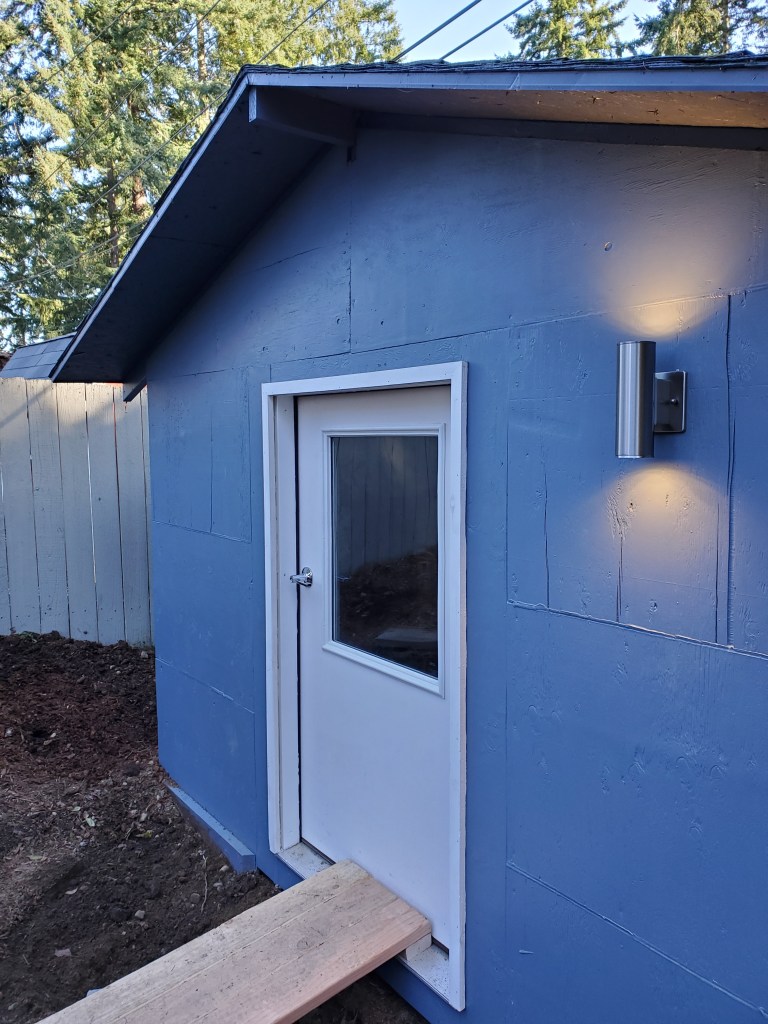
This shed-to-workshop project is coming along well. So far, I’ve cleaned it out, added two new windows, replaced the old plywood doors with a nice new door (with a glass panel for even more natural light), and given a fresh coat of paint to the door frame and exterior shed walls. Not bad.

The next step is a less dramatic transformation, perhaps, but arguably one of the most important things for a future workshop: a proper work bench.

One of the main reasons I needed some sort of workshop in the first place was just for the additional space and work surface. Sure, it’d be great to have some simple power tools (table saw and vacuum for sawdust, drills, and so on) and other equipment, and a place to efficiently store all those tools. But my single biggest need is just for some extra space – a large work bench for projects, primarily building rockets.

Butcher block work bench
butcher block work bench

I decided to go big with a butcher block countertop from Home Depot. In fact, they offer a few different sizes, and I went with the largest one they had, a full 96 inches (8 feet) in length. I found out two things about butcher block: it’s extremely heavy, and it’s expensive. But worth it!

After doing some initial research and arriving at a decision, I made the mistake of running up to the store myself and trying to purchase this alone. I could write a lengthy article just about the epic struggle of getting this thing off the shelf and hauling it to the front of the store, and loading it awkwardly into my small car (sticking partly out of an open trunk). I blocked many increasingly annoyed contractors in the store’s loading zone. I eventually managed to transport this thing home successfully, but at great cost to my pride, and my lower back.

The butcher block was unfinished wood, and this meant applying some sort of stain and/or seal to the wood, in order to protect it long-term. On a separate trip to the store, I picked up some simple clear wood stain, and also some clear polyurethane water based sealant, along with a couple of brushes.

As a side note, polyurethane can be either water based or oil based, and the difference is how they look after finishing the wood: water based is completely clear, while oil based will give the wood a soft amber look. It’s a purely aesthetic distinction and totally based on your own preference.

Applying wood stain to butcher block
wood stain

The staining and sealing process was nearly as epic as the journey from store to shed, though I didn’t realize this would be the case at first. Following the instructions provided on the can, at least two coats of the wood stain were necessary (to both the top and bottom of the butcher block, as well as all 4 sides), allowing ample time between coats to dry.

The polyurethane was even more demanding, requiring a minimum of three coats per surface. The fact that it took at least several hours for each coat to dry, and the sheer weight involved in trying to rotate this board, meant a multi-stage staining and sealing process that ultimately took more than a week.

This was also mid-winter and while Seattle winters are relatively mild, it was still cold enough to numb my hands halfway into the application of each new coat of stain and sealant. Several of those trips were done with light snow blowing into the shed, potentially ruining my otherwise perfect work.

Applying a polyurethane seal to the butcher block
polyurethane seal

Eventually, I finished preparing and protecting the board and mounted it along one wall inside the shed, centered under a window that provides plenty of natural light. Mission complete!

The only other major feature that a true workshop needs is electricity. And while digging a massive trench and running conduit and wire from my house out to the shed is an awful lot of work, it should also make a decent story, and a couple of good blog posts.